BAI launches a training program for Vocational Education teachers on parametric design applied to carpentry
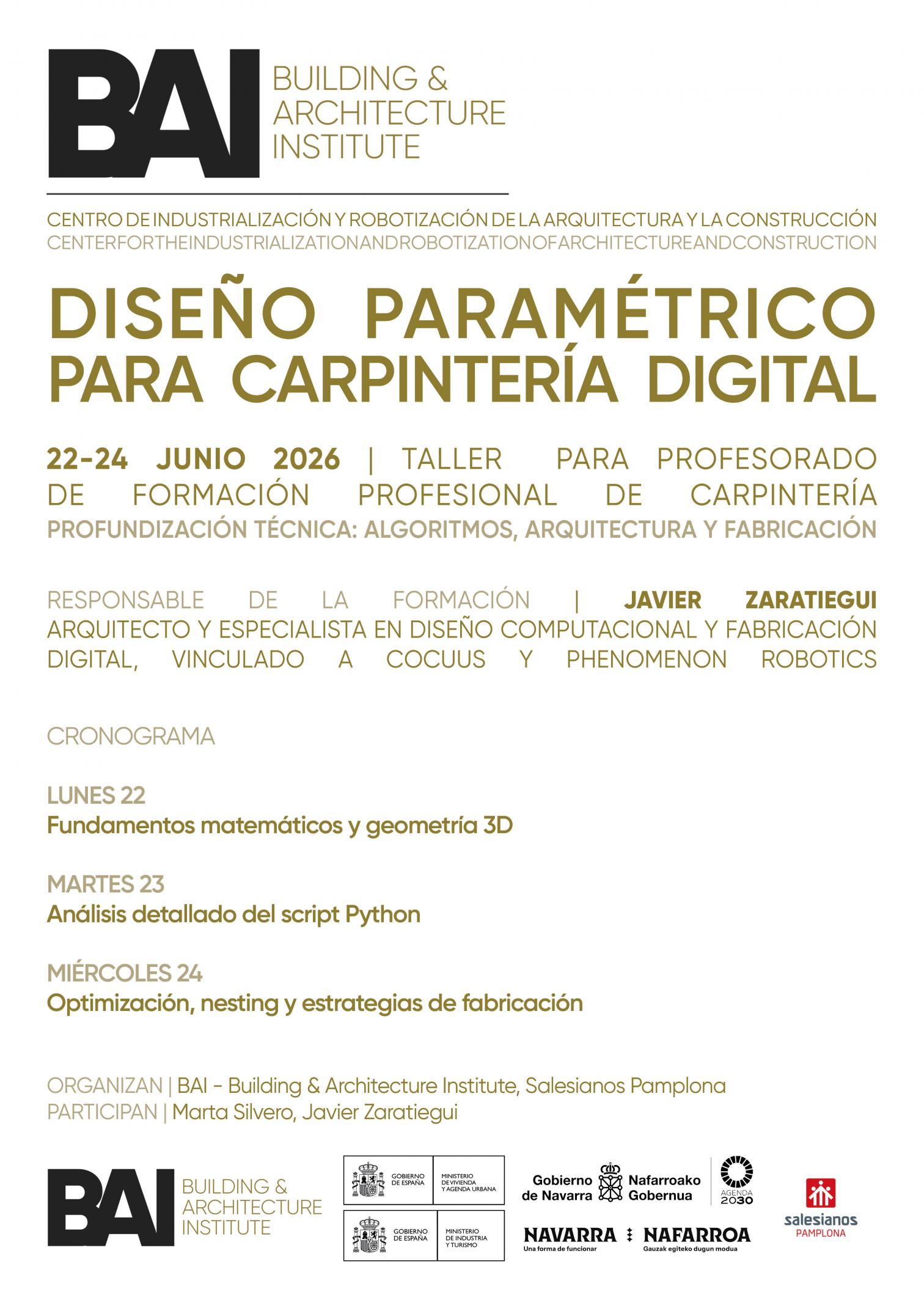
BAI will deliver a training program on June 22, 23, and 24 aimed at Vocational Education and Training (VET), specifically for the teaching staff of the Carpentry Department at Salesianos Pamplona, with the objective of bringing the digital technologies that are transforming the construction sector closer to traditional trades.
This initiative forms part of a broader line of work aimed at connecting VET programs linked to trades such as carpentry, masonry, and mechanical manufacturing with technologies associated with industrialized construction, including computational design, digital fabrication, robotics, and artificial intelligence.
The program is framed within an effort to connect two fields that have traditionally developed along separate paths: on the one hand, educational programs associated with trades such as carpentry, masonry, and construction; and on the other, disciplines linked to computational design, digital fabrication, robotics, artificial intelligence, and advanced manufacturing. BAI sees this connection as an opportunity to update professional skills across the sector and to facilitate the gradual, practical, and applied incorporation of new technologies into educational environments. The goal is to expand the knowledge base of traditional trades through tools that enable new ways of designing, manufacturing, optimizing, and building.
This first experience will involve teachers from the Carpentry Department at Salesianos, who will receive six hours of specialized training distributed across three sessions. The course has been designed to provide participants with a technical and applied understanding of a parametric design process oriented toward digital fabrication. Throughout the training, participants will work on concepts such as 3D modeling, geometry generation through algorithms, the use of Rhino and Grasshopper, Python script analysis, part optimization, nesting strategies, and the preparation of files for digital manufacturing processes. All of these concepts will be applied to a specific case study related to digital carpentry.
The training will enable teachers to understand the complete workflow, from the initial drawing of curves and profiles to the generation of three-dimensional models, the production of cutting layouts, part numbering, and the export of files prepared for cutting machinery. In this way, participants will gain insight into the technical decisions that make the entire process possible and lead to the final built result.
One of the key aspects of the initiative is its pedagogical approach. The training is directed first and foremost at teaching staff so that they can acquire the knowledge required to later transfer it to their students. In a second phase, BAI will develop a specific adaptation of the course for VET students, with content adjusted to their level and focused on workshop-based practice. This structure seeks to ensure robust and sustainable knowledge transfer within educational institutions. Teacher training is essential for the realistic integration of digital tools into learning processes and for their connection with the specific content of each specialization.
The choice of carpentry as the first field of study responds to the potential this trade offers for incorporating digital design and fabrication methodologies. The possibility of moving from a digital model to optimized, manufacturable components ready for assembly makes it possible to visualize directly the relationship between design, material, machine, and construction.
Through this training program, BAI advances its commitment to a Vocational Education and Training model that is connected to the current challenges facing the sector. The industrialization of construction requires new professional profiles, new competencies, and stronger links between traditional trades and emerging technologies.
Through initiatives such as this one, BAI works to promote knowledge transfer, technological updating, and innovation applied to construction, helping prepare both teachers and students for an increasingly digital, industrialized, and collaborative professional environment.